Articles / Subscriptions
The Subscription Price-Hike Playbook: How Companies Quietly Raise Your Bills
You think you spend $86 a month on subscriptions. The real number is closer to $219, and the gap isn't an accident, it's a system. This article breaks down five real, documented tactics, grandfathering, buried plan-change emails, feature shrinkflation, auto-upgrades, and drip pricing, that companies use to raise your bills without ever sending a notice that looks like a price hike.
Why do people underestimate subscription spending by $133?
Ask the average person what they spend on subscriptions each month, and they'll guess around eighty six dollars. A 2022 survey by C+R Research found the real number is closer to two nineteen. That's not a rounding error. That's a hundred and thirty three dollars a month nobody accounted for. Multiply that gap by twelve months, and it's over sixteen hundred dollars a year, vanishing from a single household without one dramatic purchase. No one decided to spend it. It was extracted, a few dollars at a time, through mechanisms built specifically so you wouldn't notice.
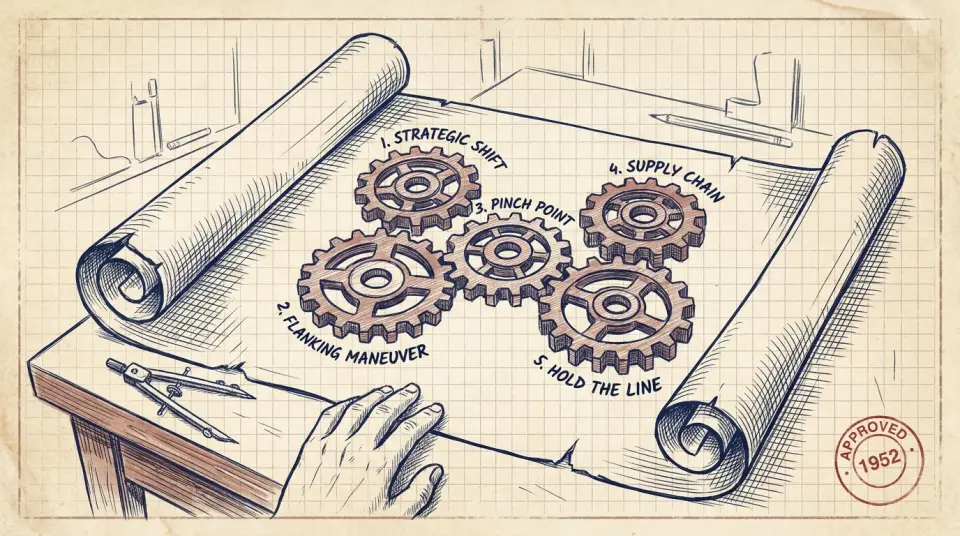
Companies call these mechanisms 'pricing strategy.' We're going to call them what they are: a five-part playbook for raising your rent on things you already own, without ever sending a bill that looks like a price hike.
Tactic one: grandfathering, then sunsetting the price
Tactic one: grandfathering, then sunsetting. A company locks in early adopters at a low legacy price, publicly praises their loyalty, then, years later, quietly retires that price tier and migrates everyone to current rates. Amazon Prime launched in 2005 at seventy nine dollars a year. It held that price for nine years. By 2022 it had climbed to a hundred thirty nine dollars a year, with the increases arriving in small jumps, each one framed as routine.
Costco did the same with its membership fee. Sixty dollars a year, unchanged from 2017 to 2024. Then a five dollar bump, the first hike in seven years, timed right after members had built the habit of never checking. Ledger entry: grandfathering doesn't cost you today. It costs you the day you stop noticing the anniversary email, because that's the day the 'loyalty discount' quietly expires.
Tactic two: the buried plan-change email
Tactic two: the buried plan-change email. Subject line: 'Some updates to your account.' Sent on a Friday. Sandwiched between marketing newsletters. The actual content, your price is going up, or your tier is disappearing, sits three paragraphs down. In 2024, Netflix eliminated its Basic plan for existing US subscribers entirely. Anyone still on it was pushed toward Standard with Ads or a pricier ad-free tier, the notice arrived as an in-app banner, easy to tap past.
Disney+ launched in 2019 at six ninety nine a month. Within four years it had climbed past ten dollars, then split into an ad-supported tier and a pricier ad-free one, each change announced, technically, but never emphasized. Ledger entry: a buried email costs nothing to write and everything to read. The average person deletes forty percent of subscription notices unopened, which is exactly the response rate the sender is counting on.
Tactic three: shrinkflation of features
Tactic three: shrinkflation of features. The price stays put, or barely moves, but the tier quietly loses what made it worth paying for. Fewer perks, slower delivery, lower quality, smaller storage. You're paying the same for less. Amazon has trimmed Prime's free same-day delivery windows in several markets and folded former freebies, like some Prime Video content, behind additional paywalls, while the headline membership price stayed the story everyone tracked.
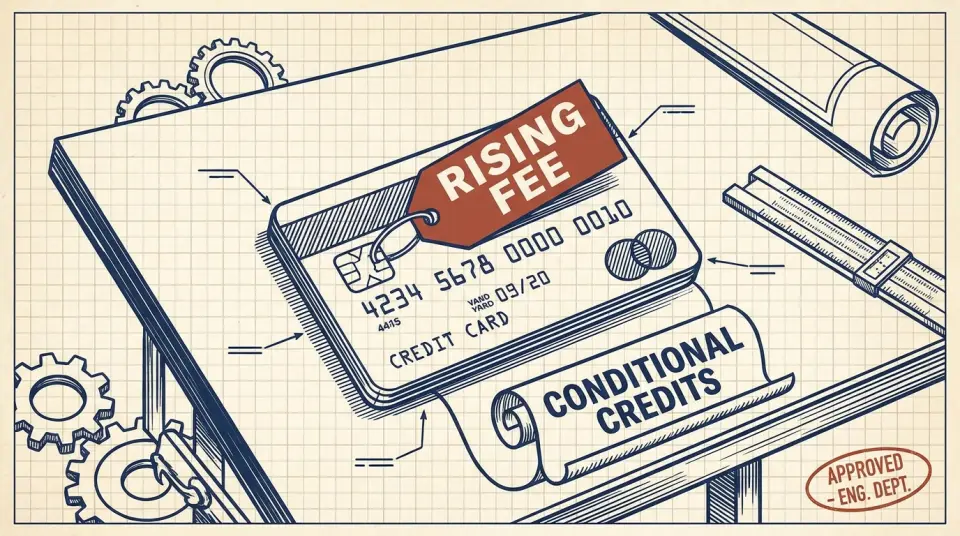
Chase raised the Sapphire Reserve's annual fee to five ninety five in 2025. That's up from five fifty just months earlier. Reports suggest it could climb toward eight hundred next, with new credits attached that only unlock if you book through specific portals. Ledger entry: shrinkflation is a price hike with no line item. You can't dispute a fee that never appears on the statement, only a delivery date that got slower, or a perk that quietly stopped working.
Tactic four: the auto-upgrade after an intro rate
Tactic four: the auto-upgrade. A free trial or a discounted intro rate rolls automatically into the standard price the moment the promotional window closes, no confirmation click required, because the default is already set to yes. YouTube Premium raised its individual plan to thirteen ninety nine a month in 2023. It had been eleven ninety nine before that. Spotify followed a similar arc, moving from nine ninety nine toward twelve dollars across two separate increases, each one applied automatically to existing accounts.
The New York Times often opens digital subscriptions at one dollar a week. That rate holds for about a year. Then it resets to roughly seventeen dollars a month, nearly a four hundred percent jump, landing on the same auto-pay card you signed up with. Ledger entry: auto-upgrades convert your inattention directly into revenue. The industry term is 'passive renewal.' The honest term is a bill you agreed to before you knew the number on it.
Tactic five: drip pricing at checkout
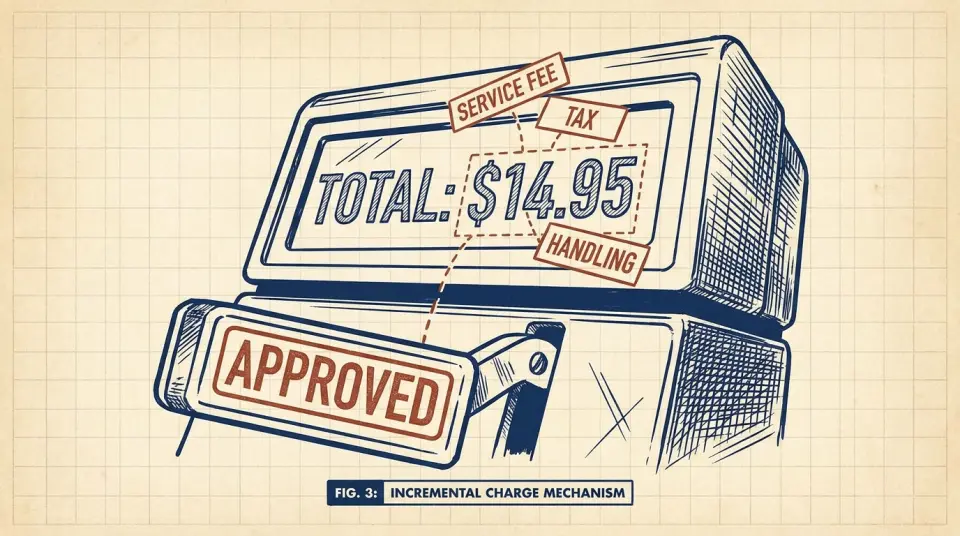
Tactic five: drip pricing. The advertised price gets you to click 'buy.' Then, one screen at a time, service fees, processing fees, and 'convenience' charges drip in, each one small enough that stopping feels more annoying than paying. A concert ticket might list at forty five dollars. By checkout, after service fees, facility fees, and delivery charges, the total often lands closer to sixty five. Regulators have specifically targeted this pattern, with new disclosure rules starting in 2025.
Airlines run the same play: a base fare draws you in, then seat selection, baggage, and 'priority boarding' arrive as separate charges, each optional in theory, each expected in practice by the time you reach the gate. Ledger entry: drip pricing is engineered friction. Every additional screen between the sticker price and the final charge exists because testing showed most people click through rather than start over.
What the five tactics cost a household over ten years
Five tactics. One outcome. Grandfathering delays the hike. Buried emails hide it. Shrinkflation disguises it as quality loss. Auto-upgrades automate your consent. Drip pricing adds the rest at checkout. None of it shows up as a single alarming charge.
Picture a household running six subscriptions: streaming, music, cloud storage, a meal kit, a gym app, and a news site. Each one crept up by roughly two to four dollars a month over three years, through exactly these five tactics. Individually, those increases look trivial, a dollar here, three dollars there. Added together, that household now pays about thirty eight dollars more per month than it did three years ago, for the identical bundle of services.
Thirty eight dollars a month doesn't sound like much. Annualized, it's four hundred fifty six dollars. Left unchecked for a decade, at the same creeping pace, that household will have handed over roughly six thousand dollars, for services that never once announced a price increase. None of this requires outrage. It requires inspection. The playbook only works on subscriptions nobody rechecks, which means the fix isn't complicated, it's just something almost nobody schedules.
Three defenses: audit, virtual cards, intro-rate reminders
Defense one: run a quarterly audit. Once every three months, list every recurring charge on your statement and its price a year ago. Apps like Rocket Money automate this, but a spreadsheet and fifteen minutes works identically well. Defense two: use virtual card numbers for every subscription. Services like Privacy.com, or your bank's own virtual card tool, let you set a hard spending cap per merchant. An auto-upgrade past that cap simply gets declined, not charged.
Defense three: track intro rates like expiration dates. Set a calendar reminder for one week before any promotional period ends. That's the exact window companies are counting on you to miss.
Grandfathering, buried emails, shrinkflation, auto-upgrades, drip pricing, five gears in the same machine, each one designed to make a price increase feel like nothing happened at all. You're not bad with money because you missed one of these. You're normal, the system is built for that. The only real defense is remembering: if a price never announces itself, that's not an accident. That's the design.
Watch this one on YouTube or subscribe to the channel for the next breakdown.