Articles / Own your tech
The Digital Sovereignty Blueprint: How to De-Google Your Life
Google disables 2,500 accounts every single day, often without warning or human review. If your life is stored in their cloud, you don't own it, you're just renting a permission slip. This article breaks down the mechanical steps to reclaiming your digital sovereignty by owning your domain, your storage, and your identity.
What happens when Google disables your account?
Every single day, Google’s automated systems disable an average of twenty-five hundred accounts. Often, these are permanent bans triggered by AI false positives. In a heartbeat, years of photos, emails, and professional contacts simply vanish behind a 'Contact Support' button that no human will ever answer. This is the 'Digital Death' scenario. When your identity is a subset of one company’s database, you don’t own your life, you’re renting a permission slip. To fix this, we have to treat your digital existence like a machine with modular parts that you, and only you, control.
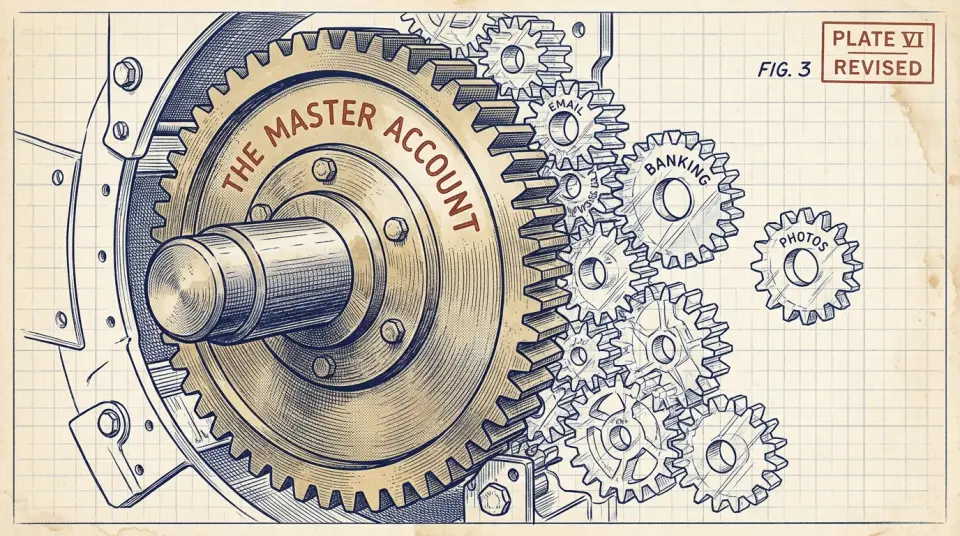
The machine currently runs on the 'Everything Account.' One password unlocks your banking, your family memories, and your work. It’s convenient, but it’s an architectural disaster. If one gear breaks or the landlord changes the locks, the entire system grinds to a halt.
What Google's free services really cost you
We begin by identifying the 'invisible taxes' of convenience. Google is not a charity. They provide free services in exchange for a granular map of your behavior, which is then auctioned to the highest bidder in real-time. You aren't the customer; you're the raw material. But the real cost isn't just privacy, it's lock-in. Google makes it intentionally difficult to leave by intertwining their services. This is the 'walled garden' strategy. The walls are high, the grass is soft, and the exit is hidden behind three layers of settings menus.
Why you need your own domain for email
The first step toward sovereignty is separating your identity from your provider. This starts with the email address. Currently, if you lose access to your Gmail, you lose access to every service that uses it as a login. You are effectively locked out of your own life.
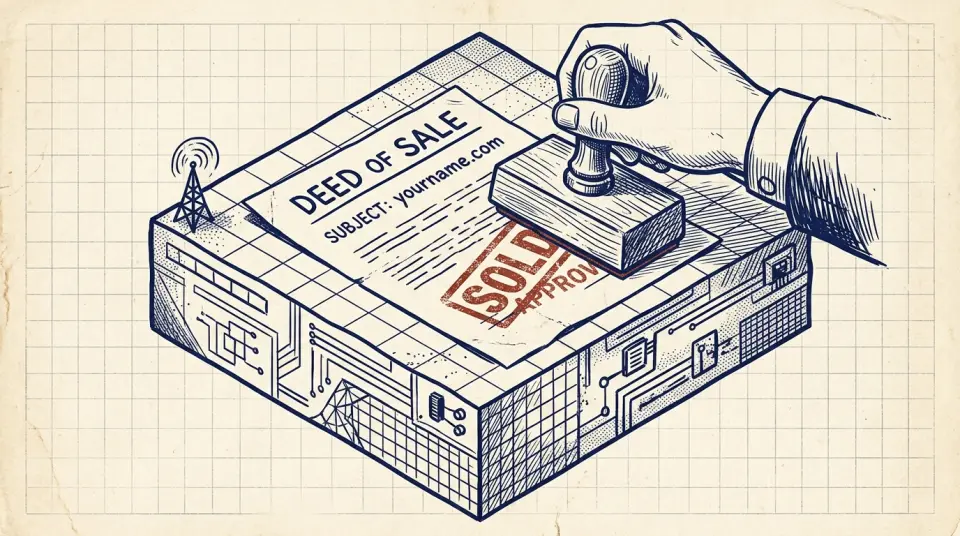
To own your identity, you must own a domain. Think of a domain like real estate for your name. Instead of renting a room at Gmail-dot-com, you buy the land. This costs roughly twelve dollars a year through a registrar like Cloudflare or Namecheap. With your own domain, you can move your email to any provider at any time. If a provider treats you poorly, you simply point your domain’s 'MX records', the digital shipping instructions, to a new service. Your email address stays the same; only the server changes.
Google One or a NAS: the ten-year cost
Let’s look at the numbers. A basic Google One plan for two terabytes of storage costs about ten dollars a month. That’s one hundred and twenty dollars every year, forever. Over a decade, that’s twelve hundred dollars for storage you never actually own. Contrast that with a one-time purchase. A high-quality Network Attached Storage device, or NAS, costs roughly five hundred dollars including the hard drives. This is a private server that sits in your home. It does exactly what Google Drive does, but without the monthly rent.
In this scenario, the 'break-even' point happens in year four. From that point on, your storage is effectively free. You’ve moved from a recurring liability to a capital asset. Ledger entry: By owning the hardware, you save seven hundred dollars over a ten-year period.
How do you move Photos and email away from Google?
Now, let's talk about the hardest part: Google Photos. It’s a masterpiece of convenience, but it’s also the ultimate lock-in mechanism. To escape, you use 'Google Takeout.' This is a tool that packages your entire digital history into downloadable zip files. Be warned: Takeout is often clunky by design. It may take days to generate your files, and the metadata, the dates and locations of your photos, is often separated into messy JSON files. This is the 'friction tax' applied to anyone trying to leave the ecosystem.
Once you have your data, you move it to a privacy-first alternative. For photos, software like Immich or Synology Photos provides an interface nearly identical to Google's. You still get the timeline view and the mobile backups, but the data stays on your own hard drives.
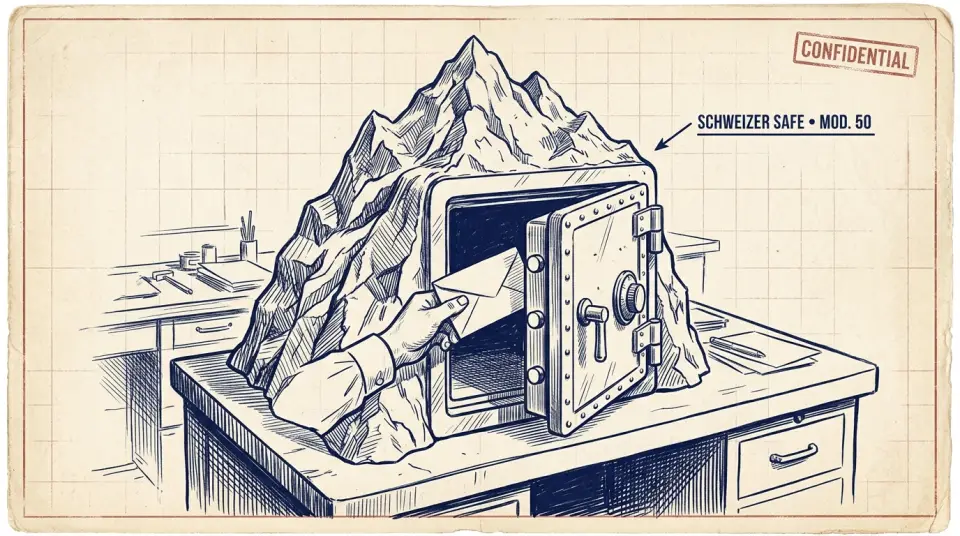
For email, the gold standard is Proton Mail or Fastmail. A professional Proton account costs about four dollars a month. It’s encrypted, based in Switzerland, and most importantly, they don't read your receipts to suggest ads for things you just bought. When you connect your custom domain to Proton, you’ve completed the most critical part of the migration. Ledger entry: Identity moved from a corporate favor to a portable asset. Total annual cost for email sovereignty: roughly sixty dollars.
What can replace Google Search, Chrome and Maps?
Next is search. Google Search has degraded over the years, cluttered with sponsored links and AI-generated filler. It’s no longer a tool for finding information; it’s a tool for finding things Google wants you to buy. This is the 'relevance tax'. Alternatives like DuckDuckGo are free and respect privacy, but for the power user, Kagi is the superior machine. It’s a paid search engine, five to ten dollars a month, that allows you to downrank 'SEO-spam' and uprank small, high-quality blogs.
Paying for search feels strange in a world of 'free,' but it aligns incentives. If you pay the company, you are the customer. If the company is free, the advertisers are the customers, and the search results will always reflect their interests, not yours. Now we look at the browser. Chrome is essentially a telemetry device that happens to render websites. Moving to Firefox or Brave cuts the cord. Brave, specifically, strips out trackers by default, saving you bandwidth and battery life on every page load.
This isn't just about privacy; it's about performance. Tracking scripts can account for up to forty percent of the data transferred when loading a news site. By blocking them, your 'invisible tax' on mobile data and time is significantly reduced. The final major pillar is Maps. This is the hardest cord to cut because Google’s data is peerless. However, Apple Maps has reached parity for most city dwellers, and Organic Maps, based on OpenStreetMap, is a fantastic, completely offline alternative for privacy.
Is leaving Google worth the effort and cost?
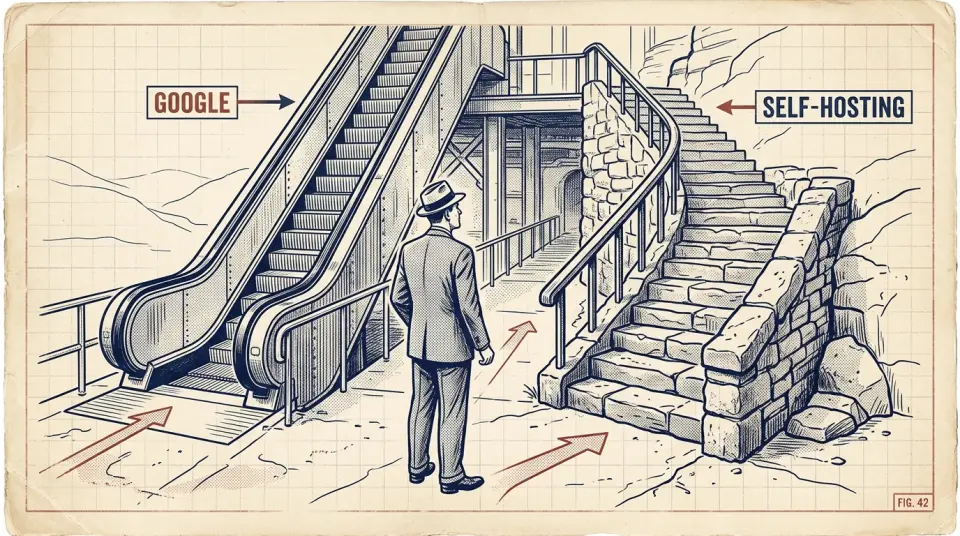
Let’s address the elephant in the room: convenience. The Google machine is smooth because it’s a monopoly. Moving away requires effort. You will have to manage your own backups. You will have to remember to renew your domain once a year. But this 'effort tax' is actually an investment in resilience. When you manage your own system, you understand how it works. You are no longer a passive passenger; you are the engineer of your own digital life.
Consider the 'Terms of Service' trap. Google can change their rules at any time. They can decide that certain types of content or speech are no longer allowed on their servers. If your life is on their servers, you are subject to their whim.
When you self-host or use encrypted providers, you reclaim the right to digital due process. Your files can't be scanned by an AI looking for patterns it doesn't like. Your emails can't be used to build a marketing profile. You regain your 'Right to be Alone'. Let’s tally the final ledger. To move from the 'Google Rental' model to the 'Owned' model, your upfront cost is roughly five hundred dollars for a NAS and twelve dollars for a domain name. Your recurring cost drops from a hundred-plus a year to almost zero for storage.
You might pay five dollars a month for a premium email service like Proton. That brings your annual 'operating cost' for a private digital life to roughly seventy-two dollars. That is less than the price of one single high-end video game.
A three-layer plan for leaving Google
The transition doesn't have to happen overnight. Start with the 'Identity Layer.' Buy your domain today. Set up a simple redirect. You don't even have to leave Gmail yet; just start giving out your new 'at-your-name-dot-com' address to new contacts. Next, move the 'Storage Layer.' Buy the NAS. Start syncing your phone's photos to it alongside Google Photos. Run them in parallel for three months. Once you trust your own machine, you can flip the switch and delete the cloud copy.
Finally, move the 'Search and Browse Layer.' Change your default search engine. Install a privacy-respecting browser. These small mechanical changes slowly starve the tracking engine of the data it needs to build a profile of you. The result is a digital life that is 'anti-fragile.' If Google goes down, or if your account is flagged by a rogue algorithm, your life doesn't stop. You just keep working, because you own the keys, the hardware, and the identity.
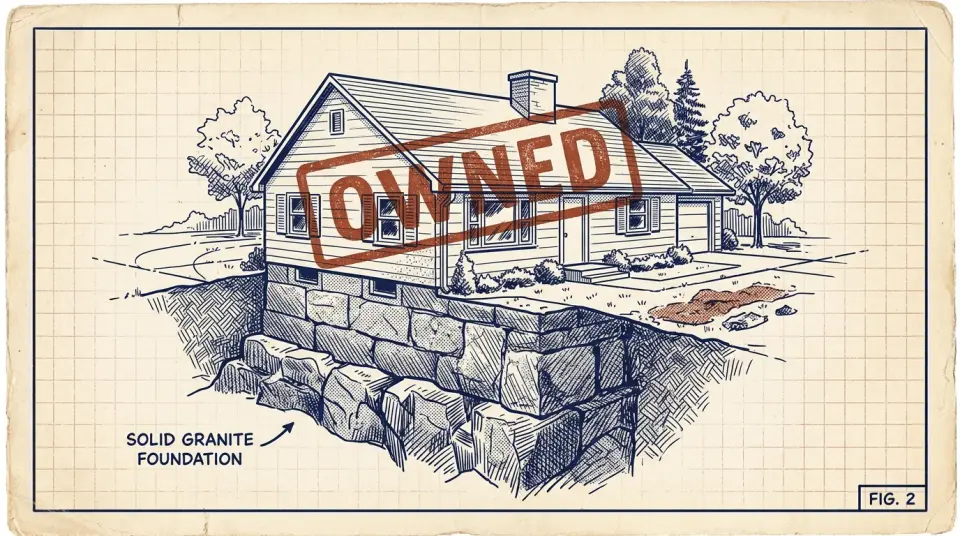
Sovereignty is not about being a hermit; it's about being a proprietor. It’s about choosing which machines you use, rather than being a component in someone else's machine. Ledger entry: Digital freedom is achieved not through 'mindset,' but through ownership of the stack. The gates of the walled garden are always open for those who are willing to walk out. It takes a little effort and a small capital investment, but the peace of mind of knowing no one can delete your life is worth every penny. Start today.
Watch this one on YouTube or subscribe to the channel for the next breakdown.